That’s easy to say, isn’t it?
It involves certain assumptions on my part – that most people’s idea of a suitable book will match my own, that everyone understands what they’re looking for, and that they can find such a thing, perhaps at short notice.
Once upon a time, I provided the required sketchbook for your Vistas holiday along with the watercolours and other equipment, but after lugging eight heavy, hardback books to Morocco – nine, including my own – and paying for extra luggage, I realised it was not something I wanted to be doing every time. I now ask you to bring your own. Although less risky than with the paints (I once tried this, too), it can easily end in frustration, if the temptation to spend less, and carry less, overrides the recommendations given, along with your own judgement.
If buying an appropriate sketchbook for a watercolour or ink painting holiday which is a pleasure to use, and will enhance your work rather than hinder it, seems like a minefield, I’m here to sweep the mines.
The important thing to remember is that not all sketchbooks are created equal. Just because they say ‘artist’s’ paper, or ‘suitable for watercolour,’ doesn’t necessarily mean it’s good enough for you. As I’m sure you’ve discovered, skimping on the quality of your materials doesn’t help you create beautiful artwork. Buying the best you can afford won’t immediately turn you into a Turner, but it will make the journey much more enjoyable.
There are several factors you must take into account when choosing the perfect watercolour sketchbook.
TYPE:
The first thing to consider when looking for a sketchbook is whether or not it is suitable for water-based media. This is defined mostly by weight (thickness), but also by texture. Very smooth papers will see your colours skating around on the surface and dribbling off the edge, not what you want at all. So, rule number one: You are ideally looking for ‘watercolour paper’, but at least a type of paper which is designed to accept lots of water.
THICKNESS:
While quick line-and-wash sketches in a tiny cartridge paper notebook are fine for a personal travel journal, if you don’t want your paper to buckle when you’ve added the water, you really need a minimum thickness of 185gsm (90lb). Many designated watercolour sketchbooks are 200gsm, and this is fine. Better still are books containing sheets of 300gsm (140lb) watercolour paper. The downside of these is that they probably contain fewer sheets. But if you can find a sketchbook of 300gsm watercolour paper with enough sheets for you to produce up to 4 paintings/sketches per day of your holiday (using both sides), then this is what I’d ideally recommend.
SURFACE:
Watercolour papers come in three textures: Rough, NOT (not rough) and HP (hot pressed). These vary from brand to brand, but possess basically the same properties.
Hot pressed watercolour paper is great for lots of detail and pen work, perfect for botanicals. It has a uniform texture similar to cartridge (drawing) paper. The difference is in the way it accepts water. Hot pressed sketchbooks are less usual than NOT ones, but can be found. I propably wouldn’t recommend one for your holiday, unless you’re already a firm fan.
Rough watercolour paper has a very textured surface which adds life and interest to loose sketches. Depending on the manufacturer, it can have an even texture, which can become a little monotonous in my opinion, or a random one, particularly if the paper is handmade. A good example of random-textured, handmade watercolour paper is from Khadi, who produce paper sheets and pads with various surfaces and thicknesses. They are made in India and considered sustainable. The very rough Khadi paper is superb for expressive colour studies, but can be tricky to use with a lot of linework, be it pencil or pen. The paper tends to be soft and easily torn. I like using this with the watercolour ‘inks’ (Painted Desert; Land of Smiles).
A NOT surface is the most common in watercolour sketchbooks and probably the most useful for our purposes, falling midway between Rough and HP, accepting fine pen lines as well as lots of water. Even within this category there are many variations. Some have an almost stripy tooth; others more honeycomb. It is a matter of personal preference as well as trial and error. Personally, I look for a subtle texture which won’t fight with the image, but which has more ‘bite’ than hot pressed.
Some decent quality, mid-range, readily available papers in this category include Bockingford, Canson and Fabriano, all of which appear in watercolour sketchbooks (sometimes bearing the name of the pad manufacturer, which can be confusing, although the name of the paper is usually – or always? – stated as well). Saunders Waterford and Arches are high quality papers, lovely to use, and occasionally found in pads – but will be very pricey.
Just to make the decision even more difficult, if you are intending to use masking fluid in your sketchbook, it reacts very differently from paper to paper. This is something you will find as you go along, and adjust your choices accordingly. You’re usually safe with Bockingford, a paper with a subtle texture, or hot pressed; less so with softer papers and it’s not suitable with Khadi.
BINDING:
I highly recommend choosing a hardback sketchbook for your travels. They are hardwearing and rest nicely on your knee. They also give a sense of occasion. It is an occasion, isn’t it?
Whether you choose spiral bound, glued or stitched pads is partly a matter of personal preference but there are a couple of things to consider.
Spiral bound
Pros: The book lays flat and the pages can be folded back on each other making it very easy to use. The pages don’t fall out, though they can easily be ripped out if you do something you absolutely hate (much as I’d advise against this!)
Cons: If you are likely to go across two pages – i.e. if your paintings tend to grow, or stretch, as you are executing them and you run out of space using just one page – the binding can get in your way and affect the finished look. I do it anyway, but you might not like the look.
Glued
Pros: A common format, there are many choices of pad within this category. It’s easy to paint across two pages
Cons: Unless you shell out more for a special ‘lay-flat’ book, you may find it doesn’t. You can train it, but it does make painting across the page trickier initially. Additionally, it’s not easy to tear a page out discreetly. Not that you’ll want to.
Stitched
Pros: Depending on the type of stitching (hand or machine), these can be attractive and often contain hand made paper. They behave like spiral bound pads or lay-flat pads but may not be as hardwearing. Machine stitched pads behave much like glued pads but it’s easier to remove pages (not that you’ll want to). Relatively easy to paint across two pages.
Cons: Hand stitched pads have the same disadvantage as the spiral bound pads to a lesser extent. They will probably be more expensive.
FORMAT/ORIENTATION:
For a Vistas holiday you are most likely to want a sketchbook in ‘landscape’ format. Choosing one with a ‘portrait’ orientation will have you either producing tiny sketches or endlessly turning it on its side. It will annoy you.
SIZE:
For almost all trips I recommend an A4 size sketchbook. The exceptions would be if I was recommending a Khadi pad which don’t come in A sizes; there is one around 20cm x 24cm which is a good size, just a bit squarer. Also for the Greece trip where we are travelling exceptionally light, we can get away with an A5 size pad – though definitely no smaller!
To sum up, you should ask yourself a few questions before deciding on which specific brand you should buy, within the recommended framework given above.
Do you like painting big – do you often end up running across both sheets in your sketchbook?
Are you a very prolific producer – do you expect to fill more than 4 (single) pages per day? What length is your trip?
The following are suggestions only. There are far more sketchbooks on the market than I’ve ever heard of, let alone tried, particularly if you’re outside the UK, but these are all ones I would use again.
Pink Pig watercolour sketchpad, A4 landscape, spiral bound, containing Bockingford paper, which takes watercolour beautifully.
These books have gorgeous, funky, handmade paper covers but only 15 sheets, so only suitable for trips lasting a week or less. Unless you bring two!
Seawhite. Classy hardback book with plain black cover, made by a small company in Brighton. The paper is off-white and quite smooth, but isn’t classed as hot pressed. Excellent if you do a lot of drawing alongside/with your painting, or if you like to write in your book, journal style. The paper is thinner than some but doesn’t buckle significantly. It is quite ‘thirsty’ so may not be ideal in A4 size in hot, dry climates unless you work very quickly with plenty of water.
https://www.jacksonsart.com/seawhite-watercolour-travel-journal-200gsm-a4-not
Fabriano Artistico Lovely watercolour paper with sustainability credentials. Slightly creamy in tone, it lends vibrancy to your colours. A glued pad which lays reasonably flat.
https://www.jacksonsart.com/fabriano-watercolour-book-200gsm
Cass Art A budget watercolour sketchbook with cold-pressed paper, spiral bound. The paper is similar to Bockingford (in the Pink Pig pads) although I personally don’t get on with it quite as well. It has far more pages, though, so it’s generally a good bet. Not great with masking fluid.
Cass Art also produce a spiral-bound sketchbook containing Saunders Waterford paper, which for many is la creme de la creme. Although the ‘portrait’ format is easier to come by, they do make a ‘landscape’ (horizontal) version which is a delicious-looking item. Unfortunately, the A4 size comes only in portrait format.
https://www.cassart.co.uk/cass-art-watercolour-wirebound-travel-book-cold-pressed-300g
https://www.cassart.co.uk/canson-artbook-wb-landscape-saunders-300g-a5–c/
Hannemuhle I have not used this specific pad but hannemuhle papers I’ve used in the past have been lovely.
https://www.jacksonsart.com/hahnemuhle-watercolour-book-200gsm-30-sheets-a4
Jacksons
Jacksons Art make their own hard back watercolour sketchbooks in various sizes. However, although these pads represent good value, I don’t find the paper as much to my liking as the others listed, and it’s a bit thinner at 160gsm.
I did not have too much of a problem with the paper cockling but now I’m wondering if they have reduced the weight. They are perhaps worth a try, though, if you’re on a budget.
https://www.jacksonsart.com/jackson-s-watercolour-sketchbook-160gsm-60-sheets-30x24cm-landscape

Khadi Lovely rough paper for very expressive painting, recommended for use with vibrant watercolour inks (Morocco, Sri Lanka on certain itineraries) or for anyone who uses a lot of water but little or no line. It accepts drawing up to a point, but is no good with masking fluid. Loosely stitched, the pages don’t always stay attached.
Bear in mind these also contain only 16 sheets. Allegedly sustainable and fair trade, they’re often out of stock so if you’ve set your heart on a Khadi pad (especially a hardback one) buy in advance!
https://www.jacksonsart.com/khadi-handmade-hard-back-sketchbook-210gsm-rough-21x25cm-16-sheets
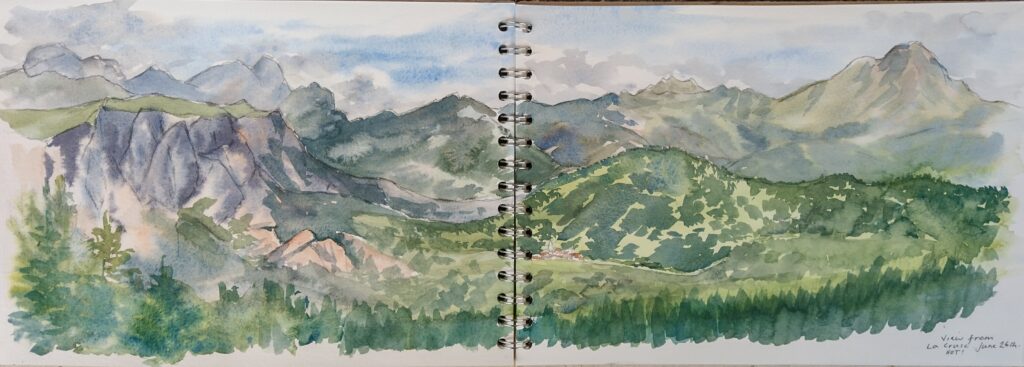
Whichever sketchbook you choose, I hope it serves you well — whether you’re joining me in Scotland, Italy, Morocco, Sri Lanka, Greece or La Gomera and La Palma.
