We’re never happy, we humans. Are we? If we live in a cold climate, we go to extraordinary lengths to chase the sun. If our everyday is hot and sticky, we seek relief in cool spaces, in shade, or immersion in water. All of this is understandable. Less so, to my mind, is getting excited about visiting a tropical destination but not wanting to feel warm. Squirrelling oneself away into a room with air-con set to sub-zero, behind blackout curtains against what one has supposedly come to experience. (And don’t get me started about people closing the window blinds on a daytime flight – that should be a prosecutable offence, in my opinion. But I digress).
The automatic, knee-jerk use of that modern day scourge, air conditioning, is unfortunate on so many levels, and I’m here to make the case.
Not only do older-style a/c systems contain dangerously ozone-depleting chemicals, but they aren’t good for your health, either. Outdated systems use additives that are highly damaging to the environment and contribute to climate change. These are now banned in the ‘West’ but are doubtless still present in some units in ‘developing’ countries, and when travelling we can’t assume otherwise.
Even new systems use a plethora of chemicals which you really wouldn’t want to be breathing in. The dry, infused air can cause sneezing, interfere with sleep patterns and shrivel up your skin as well as dry out your nasal passages, leading to reduced resistance to infection.
Lowering your body temperature to an unnatural level then going out into extreme tropical heat, then back again, places stress on your body’s internal thermostat and cardiovascular system. It’s much healthier to maintain an even temperature as far as possible. Too rapid a change – from a freezing room into hot sunshine – can even lead to thermal shock. Steady acclimatisation is a much better idea, and it makes it a lot easier to adjust to the air temperature when you do finally venture outside properly – assuming you will want to, at some point.
Air con uses a monstrous amount of electricity, especially if set to a very low temperature, or if left on all day when you’re outside. This has both environmental and local implications, as smaller accommodation operators struggle to afford the extra cost. Why be so selfish?
When you first arrive in a hot country, you’ll probably need a bit of time to adjust, and will want your room to be a little cooler than the street outside. So how to negotiate this, both healthily and responsibly? Thankfully, there is a perfect alternative that’s practical, efficient, attractive to look at, and traditional. What on earth did people do before the invention of air conditioning? Indeed, before the widespread adoption of electricity?
The humble ceiling fan has been around since the 6th century B.C. Originating in the area we now refer to as the Middle East’, they were soon adopted across the Indian subcontinent, where they were called punkah, which means ‘the draft produced by the flapping of a bird’s wings’. Anyone who has been dive-bombed by an Arctic skua can certainly attest to the rush of air produced by this activity! The original punkah loosely resembled a giant wing of a bird, consisting of a large, rectangular piece of cloth stretched over a wooden frame and hung from the ceiling.
A luxury for the wealthy, these devices had to be operated manually by a servant, who was termed a punkah wallah. A rope was tied to the punkah, which the wallah would pull to and fro, creating a pleasant breeze for those seated under it. This would require shift work, with the servant on duty seated in a corner of the room or, in some cases, in the next room, with a hole for the rope to pass through, presumably for privacy’s sake. Many punkah wallahs were deaf, as the work required them to be near to their employer at all times, and the less of a conversation they overheard, the better. It would have been useful income for a disadvantaged deaf person also, and easy enough, though the work paid peanuts.
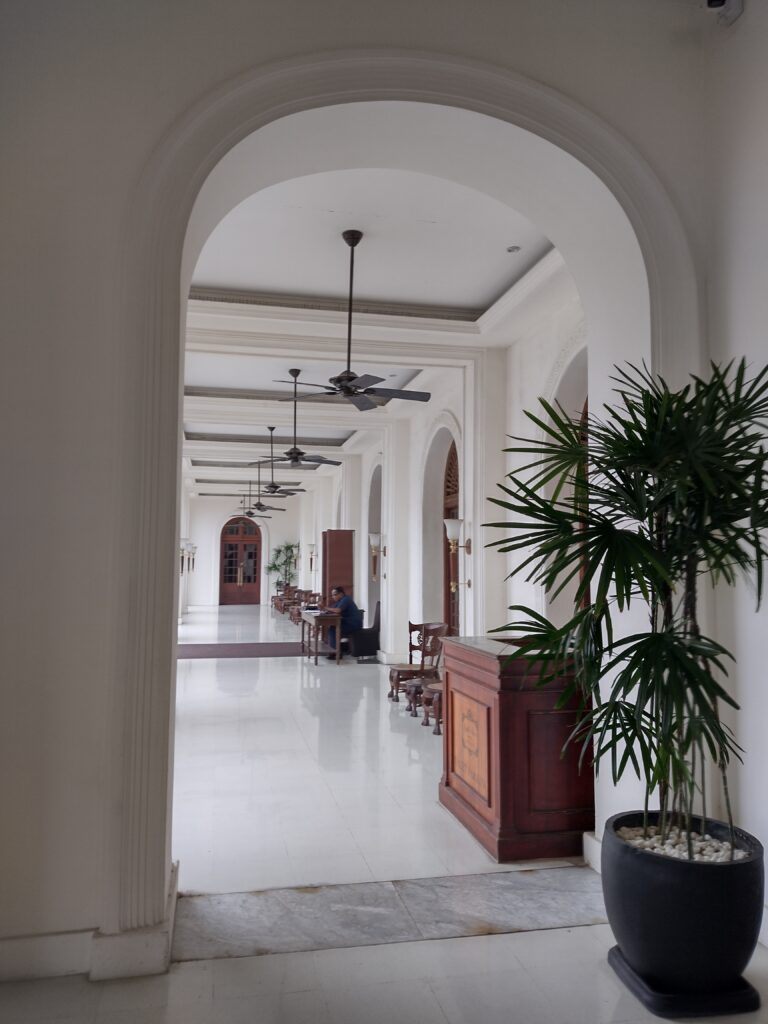
During the late 18th century, British officers who were stationed in the ‘colonies’ had to adapt to a hot, humid climate which would have been unbearable without a fan. With the discovery of electricity and the invention of the motor, punkahs morphed into the ceiling fans we are still familiar with today, and became synonymous with colonial interior style.
In humid monsoon climates, ceiling fans come into their own. Instead of circulating dry, stifling, stale air, fans use constantly fresh air, facilitating ventilation. They avoid moisture accumulation, unlike air conditioners which make the indoor air extremely dry whilst the units drip incessantly (and noisily) outside the room.
No matter its dubious origin, ‘colonial’ architecture and design is widely regarded as attractive, nostalgic and desirable; buildings from the era tend to be beautiful to our eyes and if they are restored or preserved with the original fittings – including the fans – they delight us all the more. Why, then, with such a time-tested technology available, would we choose to sleep in fridges, as opposed to with the gentle flutter of cool air against our skin?
In hot climates I will always seek hotel rooms with fans rather than a/c. If they have both, I’ll just use the fan. In most cases I won’t need either while sleeping, because I work at acclimatising myself, and take cool showers. With the air con on a very low temperature, you’ll probably feel like having a warmer shower, also, using yet more energy and adding to the hotelier’s costs. The gap between fan and air con power consumption is enormous. An old-fashioned ceiling fan will consume between 30 and 80 watts an hour, while air conditioning uses more than 1000 watts – up to thirty times more.
I’m aware that I can take horses to water, but I can’t make them drink. I’m far from perfect, but I try hard to be as responsible as I can be, within the confines of international travel itself. I also consider the local people in the place we’re travelling in rather than just taking advantage of everything offered just for the sake of it. If I’m occupying a double room by myself, and there are two towels on the bed, I use only one of them. To me, this is just polite, quite apart from the extra energy needed to wash twice the number of towels. I would implore everyone who travels on a Vistas holiday to consider the impact they’re having, and, without causing themselves discomfort, tread as lightly as they can, and be kind to people in our host country.
So when you have the option of using a traditional ceiling fan instead of air con, just try it. You may well be surprised at how much more pleasant it is. If you must use the air con, have it at a normal living temperature. That’s a minimum of 25° for me; perhaps 22° for you. Temperatures drop when the sun goes down, so you’re unlikely to need it during the night. Always turn it off when you go out. You wouldn’t leave all the lights on, would you? And in hot countries, you don’t need piping hot showers. A warm or cool shower will help to regulate your body temperature so you don’t need excessive cooling afterwards.
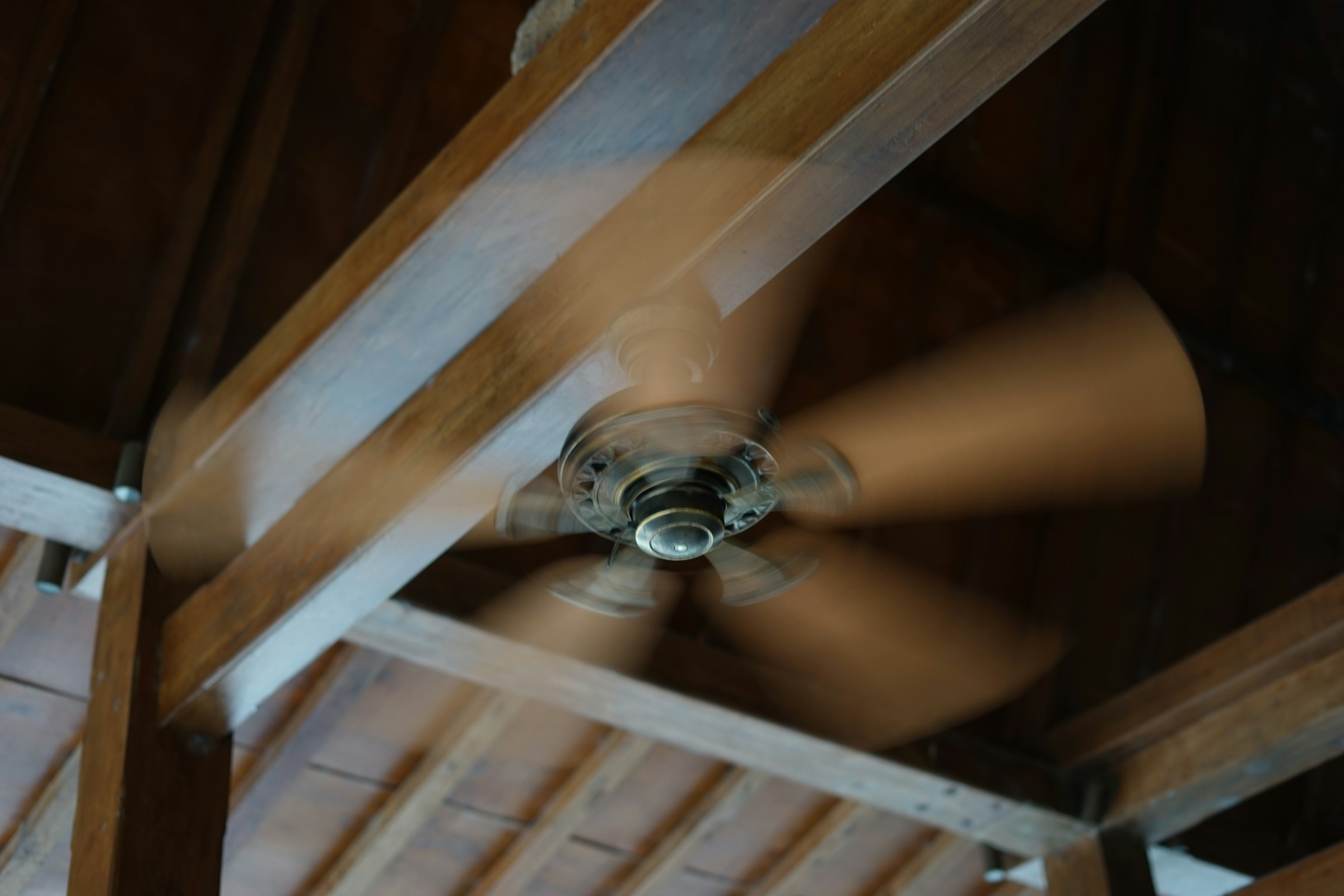
Embrace the quiet, once you’ve turned that a/c off. Hear the charming creak as your fan stirs into motion, and the gentle whoosh of air as the wooden blades circulate above you. It can be marvellously soporific.
(Feature photo by Ahmad Budi on Unsplash)
