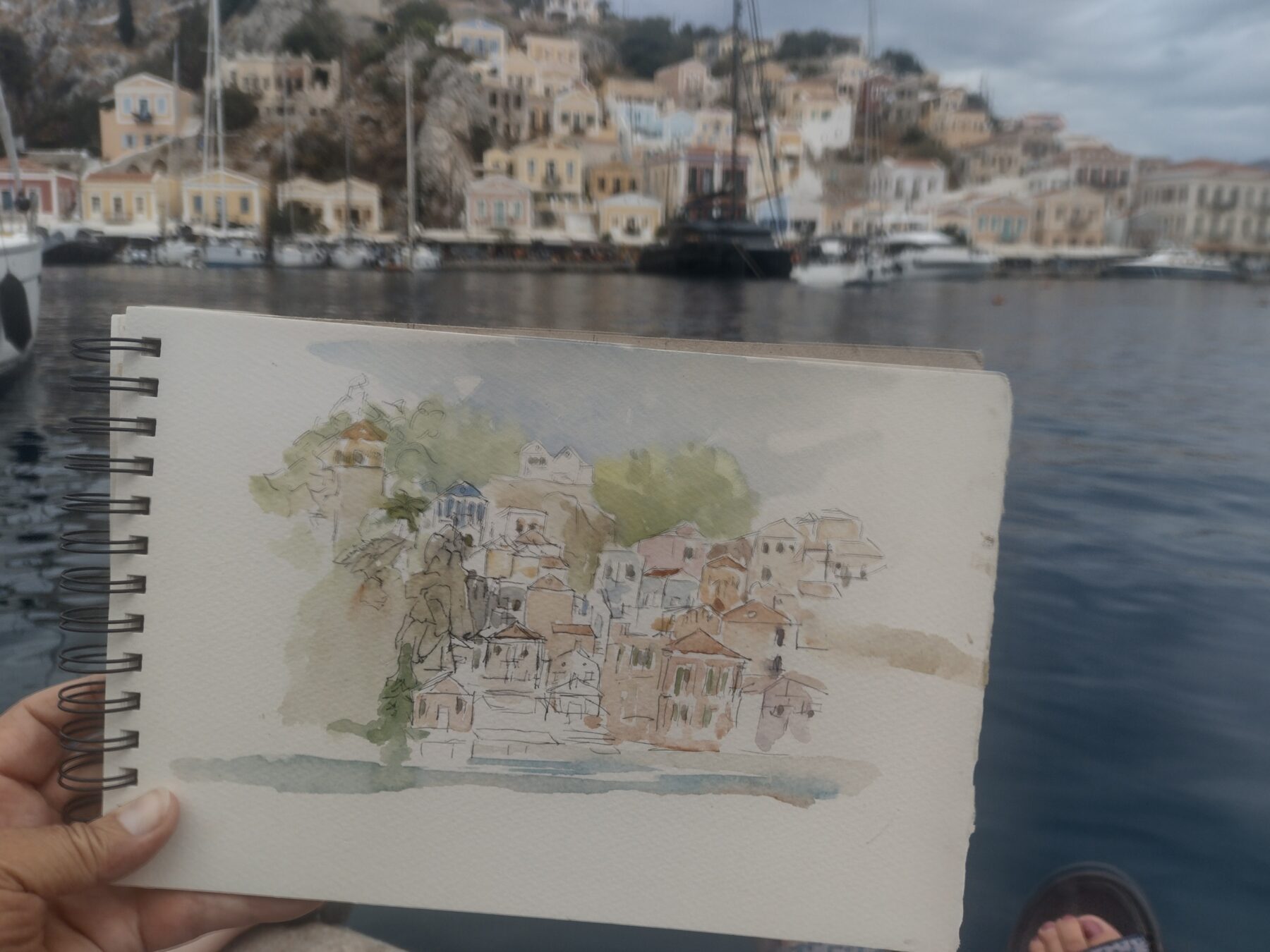
We’re on the harbourside in warm sunshine with twenty minutes to spare before the ferry is due. There’s a small hatch serving coffee in tiny paper cups, but the few outside tables along with the covered waiting area are already crammed with travellers and their mountains of luggage. We’ve just enjoyed a freshly squeezed orange juice at a shady pavement café. So, what do we do? Whip out our sketchbooks, of course!
Greek inter-island ferries don’t wait around, so we need to be ready and present at least five minutes before departure, and I calculate we have a comfortable ten minutes to complete a journal sketch of Pothia, the tiny, attractive capital of Kalymnos. Homes and chapels cling to the rocky hillsides while an array of boats of myriad colours and sizes bob about below, on the opposite side of the harbour from where we now position ourselves. Between homes and boats exists a flurry of life in and around the thriving café scene, but we can’t see it from here. If you can’t see it, you don’t paint it – at least, that’s the theory, when travel sketching.
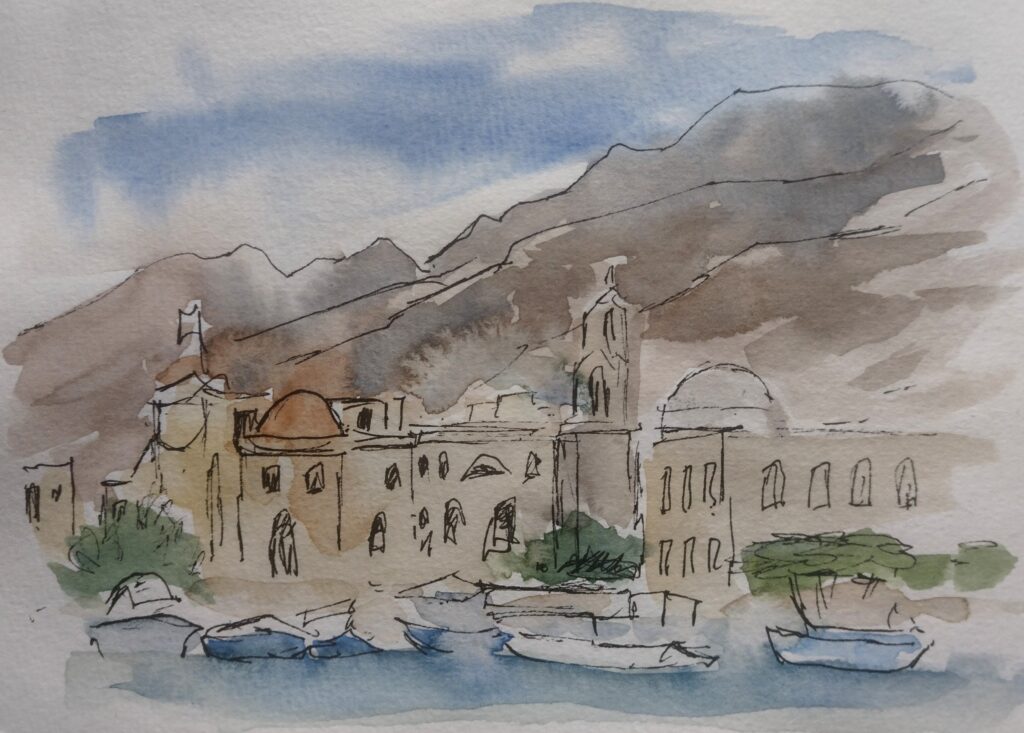
Waiting until everyone has their watercolours, waterpot, brush and pen at the ready, I set the timer and count down the minutes, letting them know when they’ve had two minutes, five minutes; then when there’s four, three, two and, finally, one minute left. There are shrieks of consternation, yet fingers continue to move, eyes flicking from the picturesque jumble of buildings and boats across the water to the page, where a lively, vibrant response is evolving, more quickly and beautifully than they could have imagined.
A shout from the dock hails the arrival of the Dodekanissos Express and we quickly snatch up our belongings, carrying sketchbooks open until the page is dry, and leap onto the ferry. Up on the deck we compare the results as we pull away from land, waving goodbye to one island and setting sail for the next.
On his suggestion, we found a spot with plenty of inspiration (in this instance a spot halfway up the ‘Lazy Steps’ from Symi harbour), and gave ourselves one hour to complete four sketches of our choice. The hour could be divided however we preferred: into fifteen-minute segments; one longer and three shorter, or to be tackled organically, taking more time over sketches deemed worth it, with the subsequent danger of being left with too few minutes for the final one. Or two. Or even three, if we weren’t careful.
Rapid sketching is a feature of Vistas Sketchbook Journeys, where we may have only minutes to capture an exceptional view or event; but the timed sketch is also a great exercise where time is not so much of a concern, but the subject matter may be complicated, challenging or causing work to become tight and fussy. Cliff, on his third Vistas holiday, suggested a twist on this activity while we were in Greece, and it worked so well it will be adopted into other itineraries.
I wasn’t careful.
I’m sure I have often remarked that one can be a decent teacher without being a great painter. And that it’s a question of ‘do what I say, not what I do!’ which is, itself, a cover for being my own worst enemy when it comes to loosening up. Undertaking Cliff’s one hour challenge along with them, I demonstrated exactly the pitfalls of this exercise to which I should have known not to succumb. Furthermore, I knew what I was doing even as I was doing it, yet I continued anyway. The results speak for themselves.
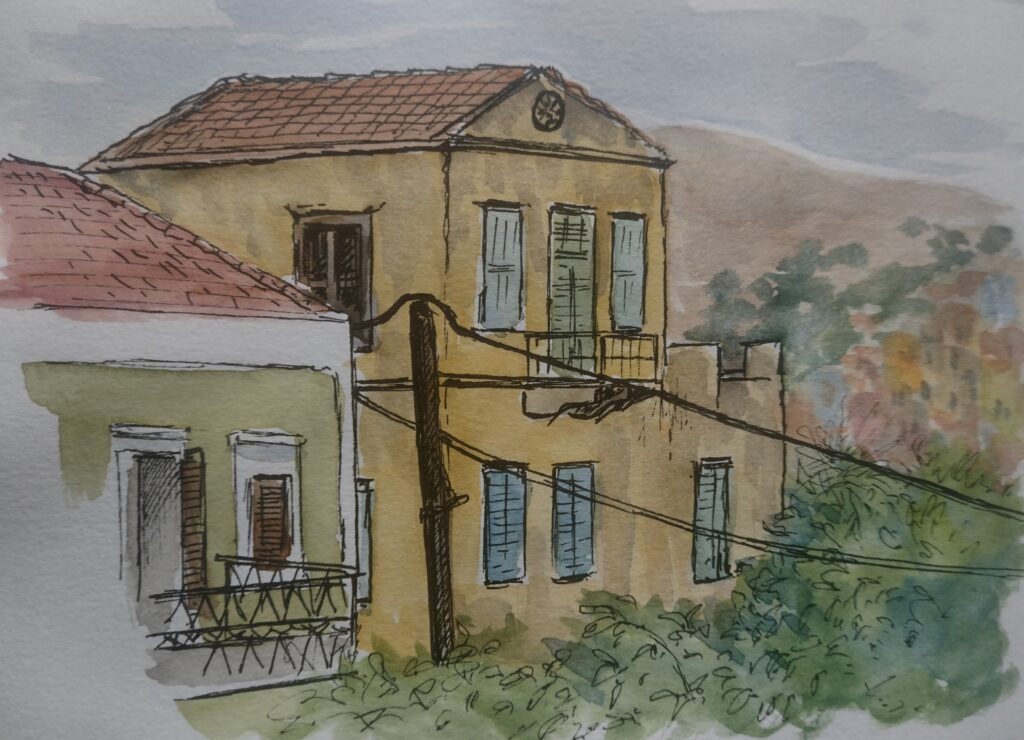
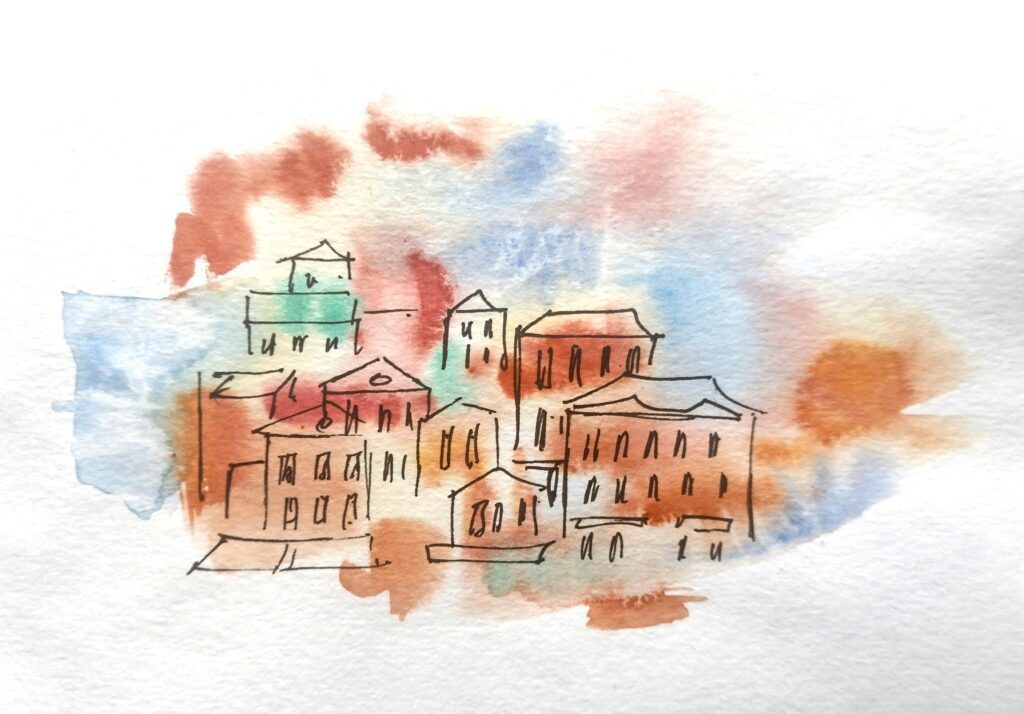
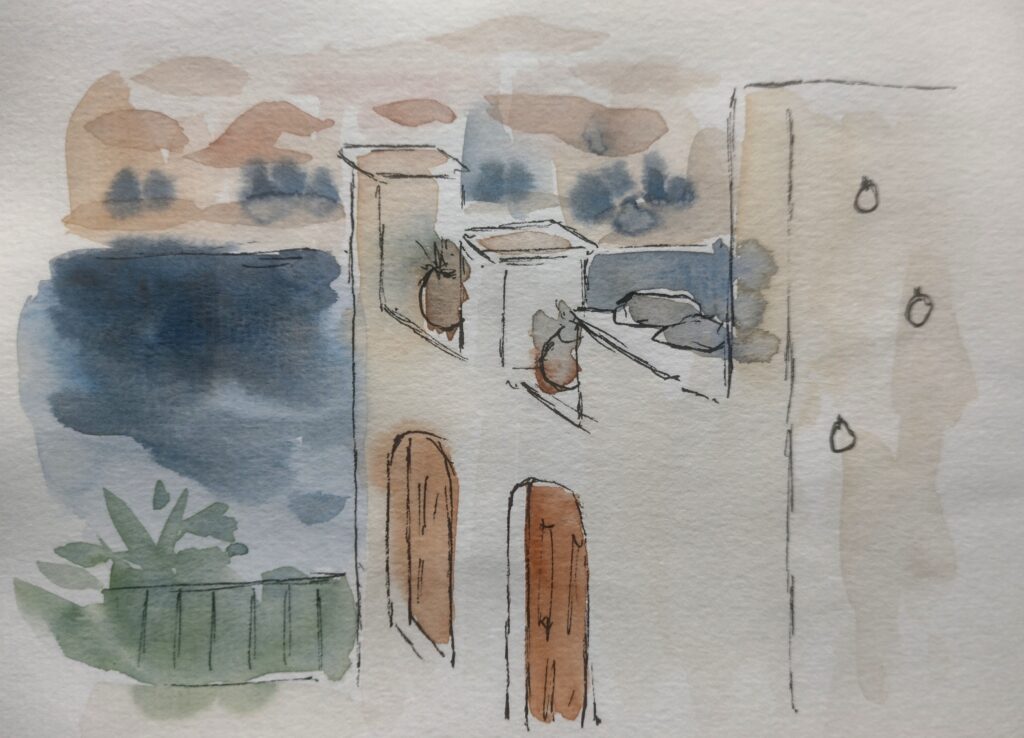
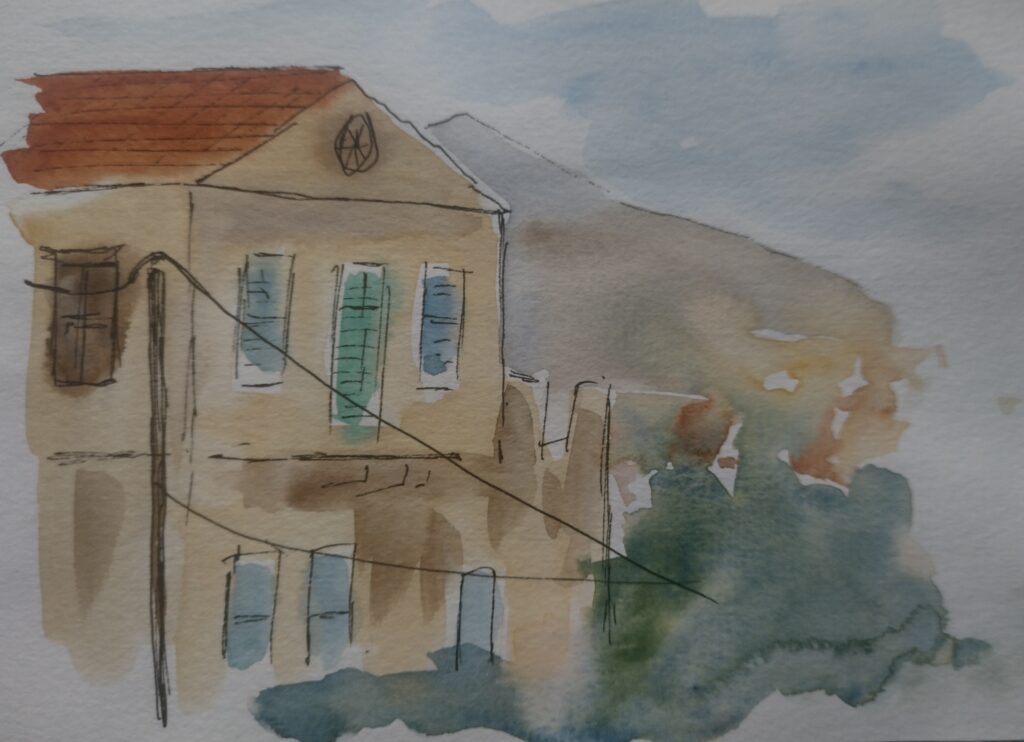
I was particularly taken with a yellow ochre house in a state of semi dereliction, or faded grandeur, depending on one’s viewpoint. I really wanted to capture this view and decided it should receive the lion’s share of my allotted hour. The subject was trickier than I anticipated, and I became entangled in a drawing which ended up devouring forty or more of my minutes, leaving fewer than twenty to complete three others. I had not even identified my alternative subjects, so caught up was I with the ochre house. Panicking, knowing I should be setting an example, I quickly threw some colour on the page in a rough depiction of the distant view of the harbour, and added swift pen lines in an approximation of merchants’ houses. This small impression took three minutes. In the final quarter of an hour I completed two paintings, one of the building in front of me and a second attempt at my favourite ochre house.
When the time was up and we put down our brushes, we could relax enough to inspect what we’d thrown together. To say it was a surprise is rather an understatement.
The others had divided their time rather more evenly, with most sketches taking between ten and twenty minutes, all of them fresh, fun and evocative. In my case, my first effort was laboured and dull, the colours dirty looking where I’d tried to show the aging of the once bright yellow paint. The second version, however, which took precisely seven and a half minutes, said so much more, whilst saying less. It was a harsh lesson I should have learned by now, having taught it countless times. I am my own worst enemy when it comes to fiddling, fussing and overdoing. If I could erase this terrible sketch from my journal, I absolutely would. But in an act of self-flagellation, I am sharing it here. The moral of the tale: When you don’t have hours and hours (or a studio) to complete a perfected, precision painting, faster is almost always better. The icing on the cake: the quicker you work, the more you can produce. By the end of the fortnight, we had all run out of pages in our Greek Islands sketchbooks. What a good job we had extra paper with us!